Electrical Discharge Machining (EDM) occupies a distinct place within the Hydratight on-site machining portfolio. While not a mechanical cutting technique in the conventional sense, it enables precision removal and modification of conductive materials where physical contact or tool pressure would be unacceptable. In the oil and gas, petrochemical, and power generation sectors, EDM is often used for components that are inaccessible, geometrically complex, extremely hard, or located in environments demanding strict Foreign Material Exclusion (FME) compliance.
At its core, EDM relies on an electro-thermal process. A shaped electrode - typically made of graphite or copper - is positioned close to the workpiece, both submerged in an electrically non-conductive fluid such as demineralized water or hydrocarbon oil. When a controlled voltage is applied, an electric field builds until the dielectric breaks down locally, creating a plasma channel between electrode and workpiece.
In this instant, a spark discharge occurs, releasing a concentrated burst of energy that melts and vaporizes a tiny volume of material. The resulting debris is flushed away by circulation of the dielectric fluid. This sequence repeats thousands of times per second, gradually removing metal in a controlled pattern defined by the electrode geometry.
Because erosion occurs without contact, there is no cutting force, no induced stress, and no alteration to the mechanical integrity of surrounding material. The absence of mechanical load is what distinguishes EDM from milling, grinding, or turning operations.
Maintaining a stable and clean machining environment is essential for consistent results. The dielectric medium plays several important roles: it cools both the electrode and workpiece, flushes away eroded particles, and ensures each spark occurs across a predictable gap. The Hydratight on-site EDM systems operate as closed-loop unit, meaning all fluid is continuously filtered to capture particles typically around 10 μm in size.
This closed circulation is particularly valuable in FME-critical environments, such as nuclear facilities or refinery compressor halls, where contamination control is mandatory. By isolating and capturing microscopic debris, EDM achieves a level of cleanliness and process containment that mechanical machining cannot easily match.
Modern EDM systems can achieve extremely fine tolerances - commonly to 0.0005 in/ft for accuracy and 0.0002” for repeatability. The precision comes from the computer-controlled regulation of pulse duration, frequency, and discharge current, which govern the rate of material removal. The process leaves a uniform finish that often requires minimal secondary polishing or measurement correction.
Furthermore, EDM is insensitive to material hardness. Traditional tools must contend with cutting forces, tool wear, and surface hardening; EDM removes material purely through electrical discharges. As a result, hard alloys including Inconel, can be machined just as readily as mild steel or aluminum. Hardness is no limitation.
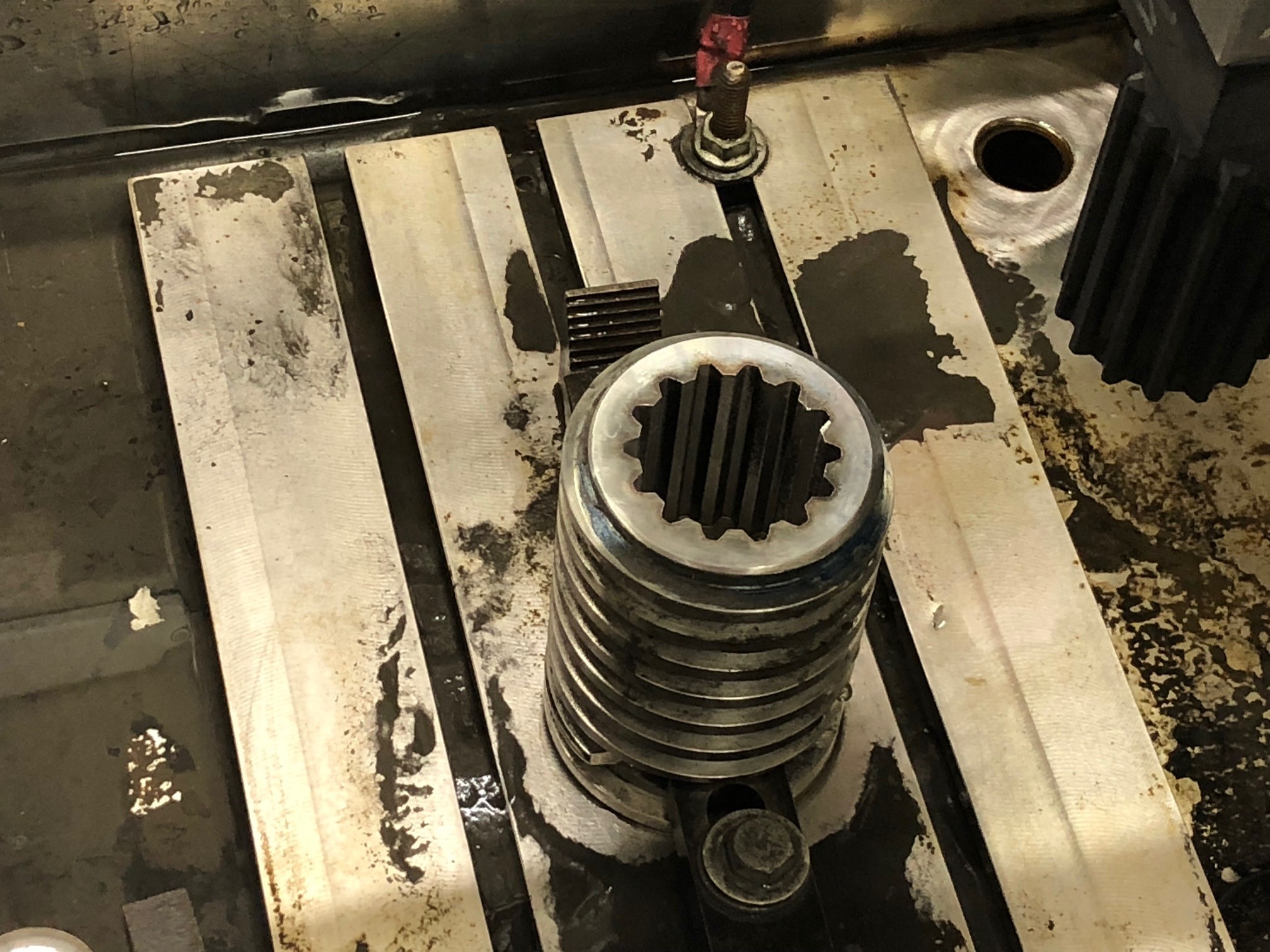
Every EDM task begins with an assessment of the workpiece material, geometry, and desired outcome. The electrode is designed to reflect the target feature, whether that be a cylindrical bore, a cavity, a slot, or the removal of a seized fastener. In repair applications, custom electrodes allow selective removal of damaged areas without disturbing surrounding zones of material.
Hydratight’s experience in on-site machining means electrode design is integrated with broader engineering considerations, including component accessibility, orientation, and system cleanliness. This adaptability makes the technique suitable for situations where small-scale but high-precision removal is required inside housings, around weld overlays, or in confined assemblies.

While Electrical Discharge Machining originated in tool and die manufacturing, its controlled, non-contact nature using spark erosion, has made it increasingly relevant to field maintenance tasks across heavy industry. Examples include:

The choice of EDM over other machining methods often revolves around four key advantages:
However, EDM also has characteristics that must be considered: it is typically slower than mechanical cutting and suitable for localized or detailed work rather than large-volume removal. Nonetheless, where tolerance, integrity, or environmental control are priorities, its precision outweighs those limitations.
By performing EDM on-site, rather than transporting components to a controlled facility, downtime is minimized and the risk associated with disassembly and re-installation is reduced. Dimensional verification and quality checks can be completed in-situ, ensuring the repair meets design or OEM requirements before the system returns to service.
Electrical Discharge Machining provides a unique capability within modern maintenance and repair strategies. It offers an electrically driven, non-contact means of achieving high accuracy and cleanliness in environments where contamination or mechanical stress must be avoided.
Through precise process control, advanced electrode design, and closed-loop filtration, EDM allows selective removal or modification of metal features directly on-site, across sectors where uptime, safety, and quality standards are paramount. For critical components in oil and gas, power generation, or nuclear facilities, it represents one of the most controlled and reliable options for precision material removal available today.
To discuss the suitability of EDM for your project contact a Hydratight On-site machining Specialist.